
Women in Forensic Computing Workshop and Bootcamp
held in cooperation with DFRWS EU 2026 in Linköping, Sweden, on March 23, 2026
Scope
Digital forensic science is the application of scientific methods of computing in order to recover and investigate evidence found in digital devices, often in relation to computer crime. Digital evidence is increasingly important in almost all types of juridical proceedings, mainly due to the increasing volume and quality of digital evidence.
The objective of this workshop is to increase the interest of students and academically young researchers in digital forensic science as a career field or a research field. Another aim of this workshop is to increase awareness and appreciation of the achievements of women in the area of forensic computing/digital forensics and therefore this workshop wishes to be a forum to help women build their technical confidence and thereby attract more female researchers to the field. This workshop is aimed at introducing new people to the area. Talks will be technical but are aimed at novices in the area. The workshop is part of a workshop series that started in 2019.
The workshop will include a sequence of presentations and panels by women that introduce some fundamental and current topics of the field and allow for first-hand hands-on experience. Attendees may also present their own work in short presentations.
Post Workshop Notes and Image
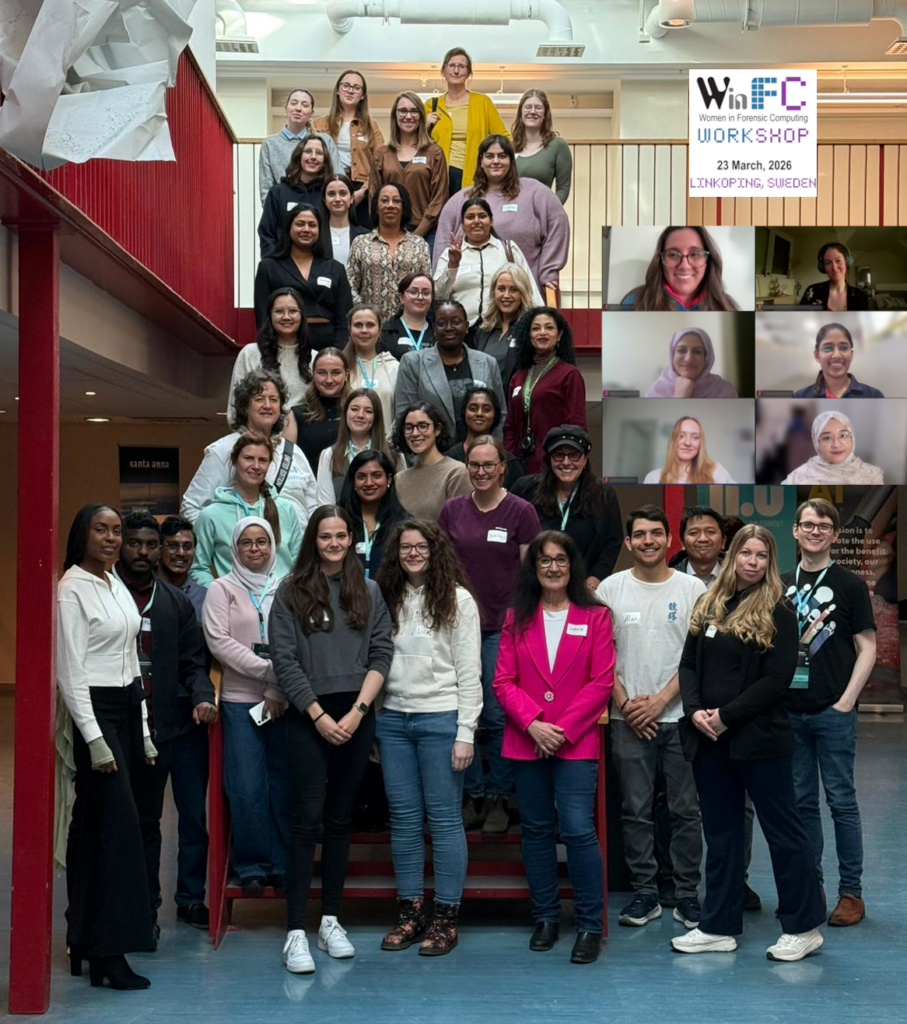
In-person and online participants of WinFC 2026. Thank you all for attending the workshop!
Location
- Room: ACAS, Building: A-huset
- Linköping University, Linköping, Sweden
Participation
Note: Unfortunately, the workshop has already reached full capacity. Registration is now closed.
Participation in the workshop is free of charge and open to all genders, but the number of participants we can accept is limited.
To participate, complete the registration form at:
- Registration link removed as the workshop has reached full capacity.
by February 23, 2026, providing details about your current affiliation, research interests, why the workshop interests you, and whether you wish to participate in person or online. Applications after that date are also possible but will be handled on a first-come, first-served basis. Feel free to apply to participate in the workshop even after the deadline!
Please also consider submitting a presentation proposal. Female participants can apply for a travel scholarship as well, but please note the earlier deadline of January 6, 2026.
Participant Presentations
Note: Presentation slots are already full. We encourage participants to submit a poster presentation instead.
Participants of the workshop have the opportunity to apply for a slot to present their current research or insights into a profession in the field of digital forensics in a 5-10-minute talk at the workshop. If you are interested, please send the title and an abstract of the presentation proposal together with the registration (see above) by February 23, 2026. Presentations can be delivered on-site or online. There will be a lightweight selection process for presentations by the organizing committee.
Posters
In-person participants may present a poster at the workshop. The poster should be about their current research. Poster presenters will give a short pitch (<1 min) before lunch, and the poster session will take place during lunch.
If you are interested, please send the title and a short description of the poster content together with the registration (see above). There will be a lightweight selection process for posters based on the submitted titles and descriptions. If you are presenting a poster at DFRWS EU, you may also submit the same poster proposal for WinFC.
Shortly after the participation deadline, participants will be informed whether their poster proposal has been accepted. Accepted presenters will then be asked to submit a PDF version of their poster to the organizers for a lightweight review.
Posters must be printed and brought by the participants themselves. We encourage poster presenters to follow the DFRWS EU 2026 poster guidelines.
Travel Scholarship
We also offer several scholarships (sponsored by FAU) for female applicants who wish to participate in the workshop: The scholarship will cover part of your travel costs and the attendance fee for the DFRWS EU 2026 conference. For applicants from Europe, we support travel costs up to 500 EUR. For applicants from outside Europe, please give an estimate for the expected travel costs in your registration.
If you wish to apply for a scholarship, please submit your application (see above) by January 6, 2026.
We will notify scholarship applicants of the organizing committee’s decision regarding whether they have been awarded the scholarship by January 10, 2026. If you need more than two months to organize your travel, please indicate this in your application by selecting the corresponding option in the registration form.
Confirmed Speakers
- Prof. Miriam Fernandez, Knowledge Media Institute, Open University, United Kingdom
- Miriam Fernandez is a Professor of Responsible Artificial Intelligence at the Knowledge Media Institute (KMi), Open University (OU), UK. Her research agenda revolves around advancing Responsible AI, ensuring that technological innovation aligns with ethical principles and societal values. Her pioneering work spans diverse domains, from algorithmic transparency and fairness to the societal implications of AI deployment. By integrating AI techniques with a human-centred approach, she fosters solutions that prioritise social responsibility, transparency, and inclusivity. With a portfolio of more than 100 scientific articles in some of the best conferences and journals in her field, and having won numerous external grants supporting her research, Professor Fernandez has significantly influenced the discourse in the field of technology development and its impact on society. Her commitment to education is demonstrated through her leadership of OUAnalyse, a strategic initiative leveraging machine-learning methods for the early identification of students at risk. This technology, currently supporting the Open University’s 200K student body, has been highly awarded for its transformative impact on student outcomes. Professor Fernandez is also Equality and Diversity Champion for both KMi and the OU, where she leads the Responsible AI stream of the Center for Protecting Women Online, a flagship initiative that plays a critical role in mitigating the harmful effects of technology on women and girls worldwide.
- Soraya Harding, University of Portsmouth, United Kingdom
- Soraya Harding is a digital forensics expert with extensive experience in mobile and computer forensics, anti-forensics, and incident response. As a senior lecturer at the University of Portsmouth, she teaches digital forensics to both students and professionals, combining academic theory with hands-on practice. She volunteers with Hampshire Constabulary and works freelance with HMP Prisons in the south-east, applying her forensic skills in real-world investigations. Her background includes roles at Microsoft and Cisco, highlighting her command of industry-standard technologies. Soraya also trains law enforcement and private sector clients, and coaches students in cyber competitions like Hackathons and Cyber912, where her teams have placed alongside top UK universities. Her work reflects a strong commitment to both the practice and teaching of digital forensics.
- Prof. Lena Klasén, Department of National Operations, Swedish Police Authority, Stockholm, Sweden and Information Coding, Department of Electrical Engineering, Linköping University, Sweden
- Prof. Lena Klasén has, since June 2018, been Research Director at the Department of National Operations and Adj. Professor of Digital Forensics at the Computer Vision Laboratory, Linköping University, Sweden. From January 2015 to May 2018, she was appointed Director of the Swedish National Forensic Centre and was part of the National Police Commissioner’s strategic and operational management teams. Dr. Klasén has a PhD in Image Coding from the University of Linköping, Sweden, and has led industrial and research organizations within Swedish authorities such as Saab AB, the Swedish Defence Research Agency, the Swedish Defence Materiel Administration, the Swedish National Laboratory of Forensic Science, and the Implementing Committee of the New Police Organization, Swedish Ministry of Justice. Her industrial experience also includes product portfolio management at Saab and involvement in starting up innovative companies. Lena has held several commissions of trust, e.g., board member and forensic expert.
- Dr. Janine Schneider, University of Augsburg, Germany
- Dr. Janine Schneider is a postdoctoral researcher in digital forensics at the University of Augsburg. Her work lies at the intersection of system security and forensic analysis, focusing on how digital traces are created, manipulated, and interpreted. She studies the limitations of forensic methods and tools and explores how adversarial techniques can be leveraged to systematically test and strengthen forensic robustness. She has several years of experience in research and teaching at the intersection of digital forensics and IT security and has published multiple articles in the field. Beyond research and teaching, she is actively engaged in academic service and community activities, with a particular focus on supporting early-career researchers and women in computer science.
Preliminary Program
Please note: All times listed in this program are in Central European Time (CET), UTC+1.
Monday, March 23, 2026
09:30: Arrival and coffee
10:00: Welcome by the organizers, Round of individual introductions by the attendees
10:30: Invited talk 1: Dr. Janine Schneider (University of Augsburg): Enhancing Trust and Resilience in Digital Forensics. Session Chair: Céline Vanini
11:00: Coffee break
11:30: Invited talk 2: Prof. Miriam Fernandez (Open University, United Kingdom): Responsible AI and the Urgent Challenge of Technology-Facilitated Gender-Based Violence. Session Chair: Katerina Kanta
12:00: Participant Presentations (7 minutes per presentation, including questions). Session Chair: Céline Vanini
- Áine MacDermott – Truth vs. Trickery: Exploring Deepfakes and Multimedia Forensics
- Natálie Binderová – When Deepfakes Become Evidence: A Procedural Perspective
- Mathilde Debrun – Can you spot the modified PDF? Let’s find out!
- Haula Sani Galadima – How Semantic Log Aggregation and Knowledge Management can improve learning in the DFIR Process
- Julie Leroy – Private Surveillance on iOS: From Attack to Detection – How Does It Work ?
- Clara Page – Detecting organized sex exploitation networks through analysis of online ads
- Unaiza Ali – Applying Digital Forensics and OSINT in Cybersecurity Investigations (online presentation)
12:55: Poster Pitches. Session Chair: Áine MacDermot
13:00: Lunch break, at Kårallen (separate building)
14:00: Poster session during the lunch break
15:00: Invited talk 3: Prof. Lena Klasen (Swedish Police Authority, Linköping University): Leading Digital Forensics – Insights from Practice, Research and Executive Management. Session chair: Áine MacDermot
15:30: Coffee break
16:00: Hands-on session: Soraya Harding (University of Portsmouth): Anti-Forensics – Issues and Challenges. Session Chair: Katerina Kanta
- Students will practice basic steganography and create alternative data streams. After that, they will examine the challenges faced by Digital Forensics Investigators and how this can be an issue when presenting as an expert witness in court.
18:00: Workshop ends
18:00: WinFC Mingle
- Right after the workshop, all WinFC participants are invited to a mingle with female Linköping University students interested in digital forensics, cyber security, AI, and related topics. Linköping Science Park will invite East Sweden Tech Women, Women 4 Cyber, and Women in Tech Sweden to join us for a mingle with snacks and beverages, where we will get to know each other during this very informal drop-in-event right outside our workshop rooms. At the same time, some of the DFRWS sponsors will join the mingle and are open to discussing job opportunities – with those interested.
You are welcome to join the mingle!
Organizing Committee
The workshop is jointly organized by the following people:
- Felix Freiling, FAU, Germany
- Katerina Kanta, University of Portsmouth, UK
- Yasin Köse, FAU, Germany
- Daryl Pfeif, Founding Member – Cyber Sleuth Science Lab, DFRWS, Digital Forensics Solutions
- Áine MacDermot, Liverpool John Moores University, UK
- Svenja Mischur, Germany
- Monika Radhakisan Chavan
- Lisa Rzepka, University of the Bundeswehr Munich, Germany
- Silvia Lucia Sanna, University of Cagliari, Italy
- Radina Stoykova, University of Groningen, The Netherlands
- Céline Vanini, University of Lausanne, Switzerland
- Lena Voigt, FAU, Germany
Artwork and T-Shirt
Feel free to use the generic workshop logo in any way that spreads the word about this workshop.

You may also visit the workshop webshop to order the official workshop t-shirt and other merchandise.